The founding fathers of Europe
Robert Schuman, l’Européén incarné, né comme allemand en Luxembourg, et plus tard
naturalisé francais au retour de Alsace-Lorraine après la fin de la première Guerre Mondiale,
était un visionaire. Il était ministre des Affaires étrangères de France.
Le 9 mai 1950 il faisait une déclaration, nommé la declaration Schuman, dans laquelle il proposait la fondation de la CECA, Communauté Européenne du Charbon et de l’Acier. EGKS en néérlandais.
Il a concu cette déclaration en collaboration étroite avec Jean Monnet, un haut officiel et conseiller francais.
La déclaration proposait de rassembler la production de charbon et acier des anciens ennemis France et Allemand- Ouest sous une Haute Autorité. Matières premières pour des armes de guerre.
Et puis éviter de nouveaux guerres en Europe, par garantir la paix dans une Europe unifié.
Autrement dit. Sur les ruins de la Seconde Guerre mondiale, ils decidièront autrement.
CECA est consideré comme la precurseur de la CEE (la Communauté Economique Européenne, EEG en néérlandais) en 1957. Et en outre, la Union Européénne d’aujourd’hui.
La structure décisionelle à resté plus ou moins la même
Important, aussi pour aujourd’hui, sont deux sentences dans cette déclaration:
“la seule unification de l‘Europe ne peut pas être réalisée dans un seul coup, ni être provoqué par une création englobante. L’Europe unifié devra sortir en concrete réalisations concrètes, où il faudra prendre comme point de départ la solidarité reélle.”
Le 9e de Mai, nous célebrons la journéé de l’Europe, la date a laquelle cette déclaration etait publiée.
The founding Fathers of Europe.
C’est comme hommage à ces deux visionaires que j’écris en francais.
Monsieur l’Europe
Une autre paragraphe en francais, aussi en hommage à un autre ‘grande personne’.
Jacques Delors. Ce président de la Commission Européénne, pendant deux termes 1985-1989 et 1990-1995 était le créateur du ‘Europe 1992’. Un plan vers l’achèvement du marché interieur. Sous son règne l’Union Economique et Monetaire a pris forme. Avec le résultat le plus visible l’introduction de une monnaie, l’euro.
Jacques Delors à decedé en 2023 à l’âge de 98.
Aussi lui était formé par les guerres. Son père gravement blessé dans la Guerre Première mondiale, disait qu’il faut trouver des moyens de compréhension mutuelle.
Il a également constaté l ínequalité des chances en France. Un thème que le suivra tout au long de sa carrière. Il préferait les syndicats à la politique, parce que “ca lui a permis à rester au contact avec la société”.
Pas à la dernière place, Delors etait ‘le cerveau’ derrière le programme fameux ERASMUS.
Ce programme fournit l’occasion à personnes plus instruites d’étudier à l’etranger pendant un certain temps, valable dans le cadre du programme scolaire domicile.
Ainsi Jacques Delors étais nommé ‘Monsieur l’Europe’.
Dans une documentaire du producteur Amar, Delors dit que “Il était préoccupé par la situation en Europe, avec le nationalisme et populisme. Et “il était decu sur l’Europe de aujourd’hui. Il manque enthousiasme, un âme”.
I now switch to english. Because most of the readers understand it better, and I wish to write
accessible.
A narrative on Eastern-Europe
A few weeks ago there was a commemoration of 20 years ago. On the 1e May 2004 10 new member-states joined the EU. Those were primarily Eastern-European countries Estonia, Hungary, Latvia, Lituania, Poland, Slovenia, Slovakia and Czechia. And Malta and Cyprus.
After a long period of negotiations, which followed the fall of the Iron Curtain and the domination of the former SU over Eastern-Europe.
To enter the internal market, which the EU is, these states had to accommodate to thousands of regulations. Moreover the transition of a centrally led communist system for most of these states, they were economically and administratively bankrupt, to a market-orientated society was intensive.
European programmes for recovery were created. And if it is by chance or not,
an unknown and famous person perhaps with french background within the Brussels bureaucracy -an acronym creator- formulated the name PHARE for this giant reconstruction programme for Eastern-Europe.
It stands for Pologne. Hongrie, Assistance à la Restructuration des Economies.
In these 20 years, these countries have made amazing change.
European journalist and watcher (ao active for the dutch journal NRC) Caroline de Gruijter made some interesting remarks concerning this period in a dutch radio programme.
“It was a day of promise. For the new members and the whole continent”. Ursula von der Leyen proclaimed. It was a night of promise. Because Europe ís promise. The promise that all Europeans can be master of their own destiny”.
The benefits are enormous. Fe Poland the average income was 1/3 of the average in the EU,
now it is ¾.
In those time there was already pressure on the labour market in Western-Europe, migrants from the East could fulfill the gap.
Thus also in this respect the arguments of the right forming parties in the Netherlands do not convince. Most of the migrant workers from Central- and Eastern European countries do work for which there is no supply of labour domestically.
And what do English voters for Brexit think, when they are confronted with failing transport and lack of nurses in hospitals ?
But is was primarily a security issue. The fear was that these countries would fall in disarray.
These countries should be offered perspective.
In hindsight it is a scary and undesirable perspective. It would pave the way for an increasing aggressive and revanchist leader in Russia, in the background.
Not long after 2004, he launched an attack on Georgia, in the frame of the disputed region of South-Assetia (2008).
The Europe of a citizen
A time ago, I travelled to Cologne to find an old girl friend. I didn’t manage, but returned home with a package of memories. I narrated them, exemplary. As the experience of a European citizen.
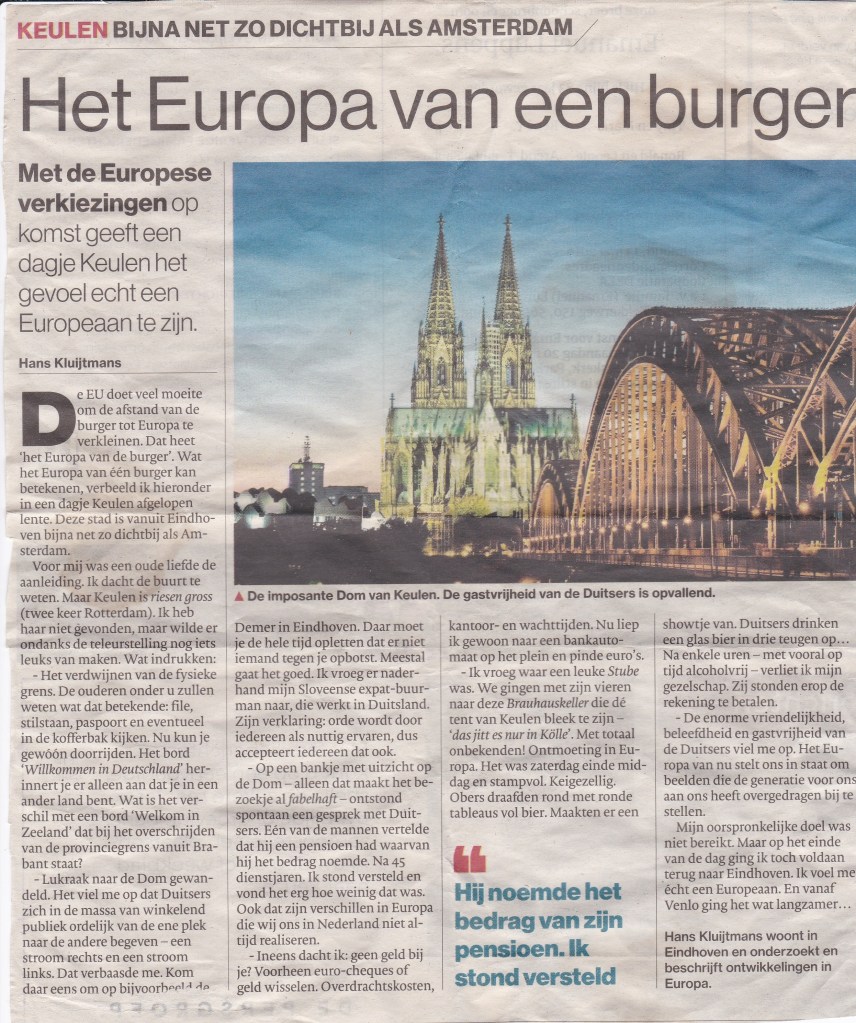
Source: Eindhovens Dagblad.
New parliamentary elections from 6th – 9th of June
After the coming elections for the European Parliament, a new European Commission
will take office. But it will be chosen by the European Parliament, which has a say in that.
Probably president Ursula von der Leyen will go up for a new term.
The prospects are a bit gloomy. After ‘wins’ in the national elections in the Netherlands for
far-right (PVV) and the parliamentary and presidential elections in Slovakia for left-populists, the expectation is that far-right parties will win.
https://www.nrc.nl/nieuws/2024/03/08/het-nieuwe-europa-kijkt-eerst-naar-zichzelf-a4192525.
The prospect is that Europe will in the first place look at itself.
The ónly good thing on this stand, is the stake on defence. The migrant policy,
agriculture and climate plans are too defensive.
For a number of reasons I find this the wrong direction.
Europe is a cradle of democracy, and freedoms. Moreover it enjoys, seen over the overall period of its existence of approx. 65 years, enormous prosperity and peace, within its territory.
Just think about that.
Europe should be self-assured in the world, without a neo-colonial stance.
Other countries look toward Europe as a role-model.
The strength of the EU is also its weakness. Its openness makes it vulnerable for
foreign influence.
United and resilient
Authoritarian regimes, such as Russia, China, Iran and North-Korea try to influence and
sow division between member-states.
We should confront that with unity and strength.
We all know that the first two states use fake-info to realise that. Fe newsmedia that act as
medium to spread misinformation and propaganda.
As a union, we should express our values. Is a (re-) formation of a radio station like
Radio Free Europe perhaps an option ?
Information, provided accessible, can be healthy ingredients for the souls of European citizens.
Or it can act as flames, stirring up the fire of false prophets.
Narratives can play a role in the European open public space. In which citizens recognize themselves.
One thing over: Europe should be ‘less elitist’.
In this respect Macron hasn’t lived up to his promise. In his former period as president,
he pledged to “rendre l’Union moins élitaire”.
For example. One thing he could work hard for, is the extension of ERASMUS to students
with a formation secondary vocational education.
Read: the German nurse does a part of her curriculum on an Italian school, plus a practical period in a hospital.
A Dutch firefighter in training does a practical period in the south of France, ravaged by forest fires. And brings this knowledge to practice in the Netherlands.

 EU - access