A succes story
Sometimes it is overlooked how the EU originated.
Europe was in tatters, as the consequence of the Second World War, which was the consequence of the First. Even later of the French-German War of 1870.
All of these wars carried the seed with them for the successor.
Áll of them ? Not the Second World War.
The genii Schumann and Monnet, with the experience of the war in mind, decided otherwise.
Why bring the former enemies together in a Community ? The European Coal and Steel Community.
And bring those commodities, necessary for waging war, under a joint decision-making structure (1952).
The two, plus Italy and the Benelux countries were members.
The succes led to an extension of the community to most sectors of economic cooperation.
Thus the EC, European Community, was born in 1957.
Feature of the EC was the abolishment of internal custom tariffs. In a period of 12 years. As a first stage of a common market.
It is not a coincidence that prosperity rose tremendously, in the late sixties and seventies. Washing machines, fridges and television sets appeared in the households.
I have a memory, no a picture, of myself playing as a toddler, on the side in a cornfield as the peasant was plowing with a horse. Not imaginable anymore ! Within the sixties horsepower was replaced by tractors.
In 1984 the plan arose for a ‘Single Act’. The Act envisioned the completion of the Single Market where all goods, persons, capital and services should flow freely.
The well-known concept ‘1992’.
The name EC changed to Union. The European Union.
European Political Cooperation was included in the treaty, as a forerunner of European Union’s Common Foreign and Security Policy (CFSP).
More tasks came within reach, so like the Economic and Monetary Union and the birth of the euro, the common currency. Realised by the Treaty of Maastricht.
More and more countries joined the EU. The former satellites of the Soviet Union, a.o.
Nowadays 28 member states exist. And several countries are ‘in the waiting-room’.
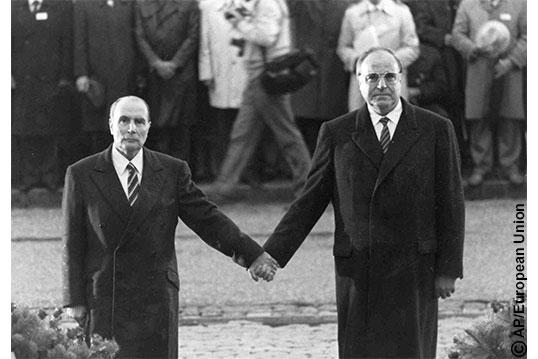
The reconciliation between the former arch-enemies France and Germany was iconically symbolised by the former leaders the German Kohl and French Mitterrand, standing hand in hand before a memorial wreath, at the ossuary of Douaunemont, Verdun. In 1984.
They also symbolised the unification of Europe [1]
Isn’t it plausible that at that time kind of complacency toward the the outside world has arisen ?
We overcame the tradional animosity between the two big powers on the European continent.
A huge success.
Looking fórward instead of looking back.
But also retiring ?
Moreover Europe was and still is protected by the nuclear ‘umbrella’ of NATO, read the US.
Europe is a peace project, but you have to prepare for war.
An insight that grows during the Oekraine war.
Revanchism
Revanchism can be described as feeling the need to take revenge after a war that is lost after losing territory, but also a political defeat. Or wanting to regain lost political influence.
In that sense, it is peculiar that on the east side, as well as the west side, Europe is bordering
on revanchist countries.
The UK during Brexit. The UK re-installed frontiers. Between the UK and the continent,
and between Northern-Ireland (part of the UK) and Ireland (part of the EU).
On the eastern side Russia tries to expand its frontiers.
The US can also be seen a increasingly revanchist.
Revanchist or populist parties are very good attuned to what lives.
A lot of citizens do not recognize themselves in politics.
They gave an answer.
The problem with those parties that they have a lot more problems with taking responsibility.
Intrinsically political issues are complicated. So ‘one size fits all’ solutions may sound very
plausible, but are in reality not achievable.
F.e in the Netherlands the recent populist governement had tried several time to abolish
precedence of asylum-seekers in the housing market. The highest administrative judge and advisor of the governement – Raad van State- advised negatively both times.
The European Defence Community (EDC)
In the same time as the foundation of the ECSC (1952) a plan was lauched by the French Prime-minister Pléven to create an European army of forty divisions, of the six original member-states of the ECSC. Which would replace the national armies.
With the WW II in mind, the Western-European countries didn’t grant the Germans an
own army. One of the arguments was to encapsulate the Germans.
Next to this plan a Common Political Community would be born. Which would take care of a common European foreign policy.
The six member-states signed the treaty in 1952, but the plan failed in the French National Assembly.
As a consequence of the death of Jozef Stalin, the fear of the Russians was diminished in France. By which the French no longer saw any point in supranational authority [2].
Later on the ministers of Foreign Affairs of the six declared to give preference to further economic integration, which led to the foundation of the EC (Treaty of Rome 1957).
A comprehensive and coherent communication strategy
We need to tell the narrative that we eradicate frontiers, instead of revanchists who raise barriers in the form of tariffs.
We adhered to a Union where everyone gave up a part of their autonomy, and thérefore got in return for that much more.
Later I will write on the communication.
In this place it is worth mentioning that the EU has in its 16-th sanction package against Russia included to tackle media agencies with a license to broadcast in the EU (February,
19-th).
An new paradigma; the time is ripe
Europe has become mature.
From 1957 on on-going cooperation and the transfer of, or entrust powers from states to a Union, has resulted in énormous growth of the economy. The arch-enemies Germany and France reconciliated forever. Frontiers are faded.
The economy is inextricably linked. Youngsters study throughover the whole Union (one of the reasons why the UK tries to get closer). Workers as well.
You can say that cooperation is in our DNA.
In 1954 cooperation is defence matters was too much.
Now times have changed. The Trump government is unpredictable but for sure it turns his hands gradually off Europe and to the Pacific.
I think we should act in two lines.
- The ‘revival’ of the plan for a European Defence Community.
2. Start a debate on stimulating cooperation between the European Defence industry.
Now the industry is very shredded.
Instead of the first proposal these are mere imaginative thoughts.
F.e. think about the European Steel and Coal Community [3].
The common market of steel and coal was based on the principle of supranationalism. The government was a High Authority which was made up of appointed representatives from the member states who would not represent their national interest but would take and make decisions in the general interests of the Community as a whole. These representatives would be independent.
Furthermore a Special Council of Ministers was composed of national ministers, a Common Assembly composed of national parliamentarians, and a Court of Justice.
This structure was a model for the later European Community.
The ESCS later was absorbed in the ‘regular’ European Structure.
‘Key’ of the ESCS was breaking the cartel structure which was the base of the
‘trusts’ in the Ruhr area that had underlain the military power of the Reich.
In a common market of coal and steel in the member states all tariffs and non-tarif barriers such as subsidies and discriminatory practices were to be abolished.
The High Authority supervised the market and with powers to handle extreme shortages of supply or demand, to tax, and to prepare production forecasts as guidelines for investment.
That mechanism can perhaps act as a model ? A director role.
European defence industry could compete freely on a European defence market.
Cost-efficiency would rise. We would be less dependent from the US.
A possible European army would lead to further economies of scale.
In the tank producing sector I know the German Rheinmetall and the Italian producer
Leonardo. They invested in a joint-venture to produce armoured cars and tanks.
Together they acquired an billlion deal for the construction of a tank for the Italian
army.
In aerospace you have Dassault in France, Saab-Viggen in Sweden.
Perhaps cooperation projects could arise because of a European defence market.
In the civil sector, the Airbus is a well-known succes story. A cooperation between
Germany, France and Spain. The group produces half of the jet planes in the world.
European Defence Community
I see the following advantages in the founding of a European Defence Community:
- Tremendous cost savings are possible.
- Cooperation between the member-states on defense creates
a unified stance on security issues related to outside threats like to be informed, to deter and to act. - Avoid playing out European member-states against each other.
- A unanimous position makes Europe visible and predictable;
- Respond to hybrid warfare.
This is a concept which describes coordinately the whole of tactical components
to destabilize the enemy by a combination of conventional warfare, irregular warfare and non-military actions.
For example think about fake-news, election intervention, sabotage.
For example the sabotage act of the Russians by spraying mounting foam in the exhaust pipes of hundreds of automobiles in German federal states, in the run-up for the recent parliamentary elections. Sender (with a sticker) the Greens.
Step by step in a European defence Community
Schumann saw the European integration as a result that will be realised by small steps.
The probably next prime-minister elect of Germany Merz said last after his siege in the
national parliamentary elections that he considered the European integration as a step-by-step to be realised goal.
Perhaps we could connect to the Pléven plan mentioned above.
In a first stage cost-reductions will not be that high.
According this plan forty divisions under supranational authority would come into existence, consisting of smaller units of the armed forces of participating countries.
Germany and the Netherlands have already one joint brigade. The first German-Dutch
Army Corps. The Dutch 13e light Brigade is integrated in the 10e German Pantzer Division.
Quick deployment is a key element.
The original six member-states of the EU -France, Germany, Italy and the Benelux could
act as pioneer.
Probably the others will join in a later stage.
My guess is that several of them, the Baltic States and Finland and Sweden are keen to join.
The organisational structure of the plan Pléven was a Commissionary that consisted of nine people who would only act in the interest of the Defence Community and would take their decisions by a normal majority. In this way the Community would have an downright supranational character.
In the command over the European army a strong role would be reserved for the operational commander-in-chief of the NATO (the Supreme Allied Commander in Europe – SACEUR).
In this way not all existing structures will be left.
The international developments follow each other quickly.
There is a sense of urgency and impetus.
Europe should think future-oriented.
[1] AP/European Union.
[2] https://nl.wikipedia.org/wiki/Europese_Defensiegemeenschap
[3] https://en.wikipedia.org/wiki/European_Coal_and_Steel_Community

 EU - access