Today Hungary stands at a crossroads. For the first time since Orban is at power, a serious opponent
challenges him in the presidential elections.
Hungary is and has been a crossroads in Europe. Lying in the centre of the continent [1].
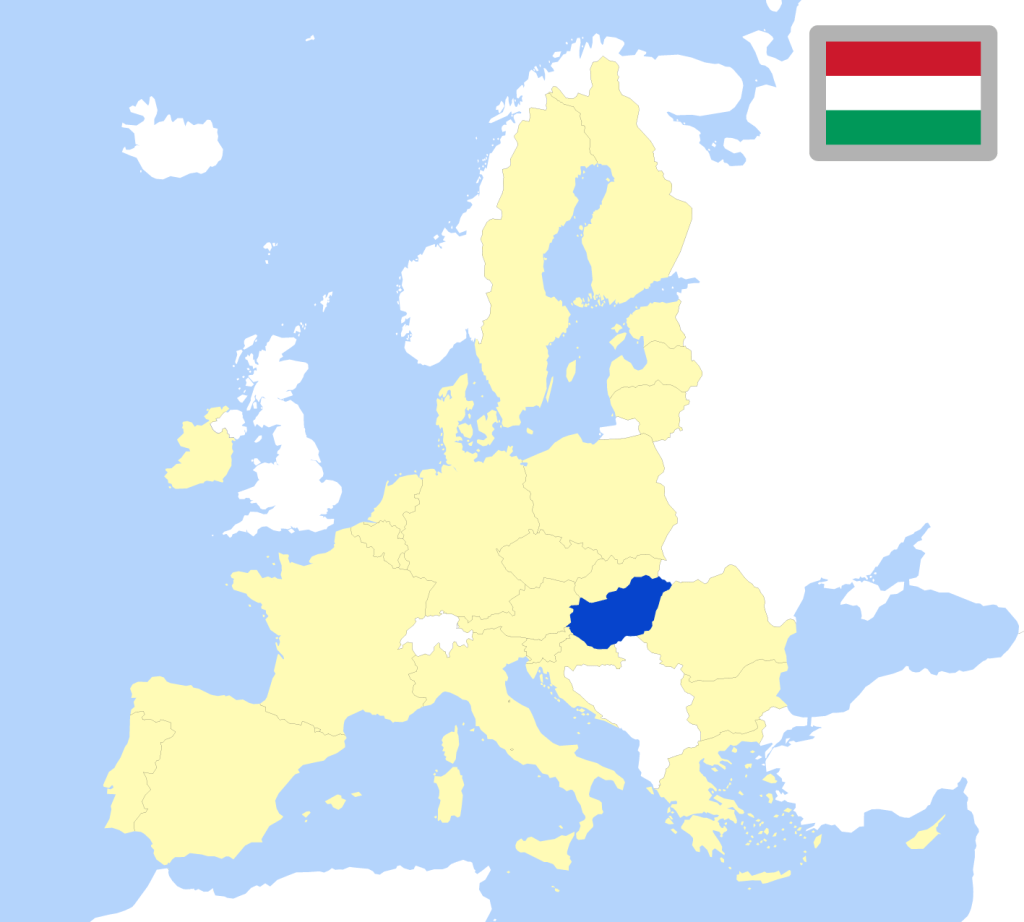
Until the end of WW I Hungary was part of the ‘Doublemonarchy’. The former Habsburg Empire fell apart in Austria and Hungary, but Hungary lost 2/3 of its territory.
A first experiment with democracy emerged but this experiment with the so-called ‘Counsel Republic’ ran ashore. It was anyway a time of new ideas, think about the Weimar Reublic in Germany.
During WW II the dictator Horthy tried to regain a part of the lost territory by consulting the nazi’s – a part of Slovakia and Transsylvania-. By which the number of ethnic Hungarians grew considerably.
Problem was that ethnic Romanians became part of Hungary.
In 1944 he was abducted by the nazi’s, because within sight of the nearing German defeat he searched contact with the Allies, and the country was occupied by the nazi’s. A horrendous number of jews were carried away and murdered in the concentration camps.
Áfter WW II Hungary was occupied by the Soviet-Union. A second attempt to create a democracy failed. In 1989 the Wall fell and freedom arose. The heroes of the revolt of 1956 against the Soviet-Union were rehabilitated.
Still yet a considerable number of Hungarians live in other member-states of the EU, a.o. Slovakia and Romania. And a part in Ukrain. These are entitled to vote this Sunday, in case they retained their nationality.
If you consider the history of Hungary over all this time, you can state that Hungary has only experienced short terms of democracy [2].
These historic experiences have formed the national collective memory.
And that is ‘the card’ that mr Orban is playing. ‘Brussels’ as another controlling agency.
Will Hungary choose at the crossroads for a place which lies in the middle of Europe ?
The benefits of the European Union are obvious. Free trade within the European space.
Common politics in many areas. Last but not least the huge amounts of subsidies which enable areas lagging behind in economic development to develop. This is surely the European idea in practice.
Foster the development of the Union as a whole by assisting all areas, also the weaker, to benefit.
You can find boards with these textes, everywhere in Europe where projects ar co-funded by the EU.
Solidarity [3].
A member state cannot bear only the benefits, but not the burdens. “You can’t have your cake, and eat it too”, a well-known English saying sounds. Membership of the EU implies, next to benefits, obligations such as the rule of law.
Since 2022 the European Union has a new instrument to block subsidies to member states that do not fulfill their obligations regarding the ‘rule of law’, i.c. Corruption and the erasing of the independence of the judiciary. It applies to Hungary and Poland.
It is called the article 7 procedure: ‘the rule of law test’. Member states can decide on this application with majority of voting.
As a result of the EU, peace endures at the continent for more than 70 years.
In a certain sense, the argument of Orban that no money should go to Ukrain, is a rehearsal of the old narrative. Ukrain should shell their own beans.
A persistent veto of Hungary is not the right way, it obstructs the development.
There is no question that national sovereignty is extradited. We all give up a part of our sovereignty, but get back a multiple in return !
The role of the superpowers
The former superpowers and enemies US and Russia try to influence the outcome of this important elections.
The inconstancy of present geoplitics shows itself, by efforts by the both of them, in favour of the present leader Orban. Vance on visit to Orban.
And attempts by the Russians, fe by sabotage of a pipeline in Serbia, and other ways.
For more backgrounds see the following article on my blog: https://eu-access.blog/2025/03/01/european-unification-a-beacon-next-to-revanchism/.
This Sunday will be the outcome.
The name of the challenger of the power is Hungary.
For a position at the crossroads of Europe.
[1] https://european-union.europa.eu/principles-countries-history/eu-countries/hungary_nl.
[2] By the way, also Poland has little experience with democracy, which explains the substantial appeal of PiS, the populist party in Poland.
There was a very interesting programme at Klara, the Flemish radio, with a scientist. I don’t remember the programme name. He explained a part of the aversion of several East-European parties against ‘the West’ stating that those countries passed all at once from dictatorship to the whims of the free market
[3] https://ec.europa.eu/regional_policy/information-sources/logo-download-center_en.

 EU - access