The ‘raison d’être’ of the European Union and its predecessor the EC was to overcome the
eternal rivalry and conflicts between Germany and France, which had resulted in three major wars.
The EU was succesful in that, visualised by the epic handshake between the resp. former leaders Kohl and Mitterand.
In his article I will reflect on the present situation of the Union, its challenges and take a daring but
visionary perspective.
The present situation
In many ways the EU can be considered a great success.
Internal tariffs were abolished in the first phase, from 1957 to 1970 over a period of twelve years.
A common external tariff took the place over. Besides a common agriculural policy was created.
Prosperity rose incredibly in the sixties. Fridges, television sets etc came within the reach of millions of Europeans. The agriculture was mechanized. The plougher with horse was replaced by a tractor.
It is worth mentioning in this respect that part of this success is certainly owed to the Marshall plan of the US. To restore a European continent that was in tatters afther WW 2 by providing financial assistance, which was in the interest of the US.
The ‘Schuman’ declaration on 9-th of May 1950 can be considered as the origin of the European integration. Schuman was the ‘embodiment’ of the European idea. He had the German nationality, was born in Luxembourg, and naturalised as a French citizen after the return of Alsace-Lorraine to France as a result of the ending of WW I.
He became minister of External Affairs of France.
The declaration was composed in close cooperation with Monnet, a higher ranking French official.
The declaration proposed the creation of a European Coal and Steel Community. A model bringing the heavy industry of the former rivals Germany and France under a joint Authority (ECSC). In order to prevent war in Europe forever.
The ECSC can be seen as the precursor of the above mentioned EC, which was founded in 1957.
Two important words of the Schuman declaration
In French, like the declaration was:
“la seule unification de l‘Europe ne peut pas être réalisée dans un seul coup, ni être provoqué par une création englobante. L’Europe unifié devra sortir en réalisations concrètes, où il faudra prendre comme point de départ la solidarité reélle.”
The unity of Europe can only emerge by concrete achievements, whereby it is necessary to take genuine solidarity as a starting point.
This implies that the unity of Europe is achieved step-by-step.
The EU; a economic giant with feet of clay
The GNP of the EU is approx. 18 billion euro. It is one of the largest economies in the world.
A comparison. The GNP of the US is 32 billion euro and China 22.
In trade. The EU is the largest exporter of goods and services in the world. 14 % of world trade.
As regards goods, the US is our main importer. Followed by China. As regards services, the US as well as the UK are 1 and 2 on the list. Most EU-countries export between 50 % en 80 % of their goods to other member-states.
The population in the EU amounts to almost 450 million. 5,5 % of the world population. It is expected that until this year (2026) the nummer will grow steady and then fall to 420 million in 2100 [1].
The challenge. ‘Power is rarely shared voluntarily’
Pre-eminently the member-states are capable of further political and defense integration.
For they are the original countries in Europe -France and Germany- who after fighting three devastating wars (of which two were global) decided to create a Community in the fifties.
To overcome the hostilities, and create an ever lasting co-operation. In the first place in commodities which stand in the production of military goods, coal and steel.
Isn’t a political and defense union a logical step resulting from this ?
Paul Krugman, a former Nobel prize winner in economics, speaks in a recent interview in ‘the Melkweg’ in Amsterdam “that this is the demonstration actually of European potential independence. You don’t need the US to defend your Eastern gate”.
“The US spends not any dollar anymore on Ukrain but with help of Europe Ukrain survives”.
The EU ís a superpower if it chooses to be one. Both economically and demographically. It certainly has the resources to stand up against foreign agression, to stand up for democracy. It does not need the US”.
He speaks about “learned helplessness. Europe has too long relied on the US to take national security decisions, but now stand up for yourself”.
Pretending that this is the America that you were used to, is just illusionary. And it delays the process to take things on your shoulders”.
The debate leader raised the suggestion on the end of the interview if “we in Europe don’t believe that we are a superpower and to make these big decisions”.
The sovereign national state is pre-eminent, states the scientist Zielonka in this article. But can national states still fulfill the traditional state functions on areas such as social, monetary or defense policy ?
He is making a plea for ‘the Fifth power’. The power of regional and local authorities, and NGO’s.
The confidence in the national state is dramatically low.
From the Eurobarometer the figures are clear. 52 % of all Europeans have trust in the EU, while confidence in the national governments ranges much lower 37 %, and parliaments 36 % [2].
Two of the major issues in European politics in the last decades, Schengen and the Euro have shown
success. Of real solidarity. After deep crises. Ironically it were the issues that prompted the UK to leave. And now voices to reconsider it are increasing.
The monetary crisis revealed itself in Greece. This is the result.
Populist leaders as Wilders declared: “no euro anymore to the Greeks”.
Schengen, the free movement of the citizens within the European area, was threathened by national border controls. Please note the judicial verdict was on a border control in Schengen concerning a.o. a professor who visited a conference in ‘Schengen’.
A increasingly multipolar world.
From friend to foo. With an unimaginary speed the US of Donald Trump takes distance from, and criticizes Europe. He sees nothing in the European integration.
Yes, he has a point that Europe should not rely anymore, or at least partly, on its willingness to defend Europe.
But his and fe Vance’s criticism, and willingness to support extreme right to disorder Europe is unprecendented.
He threatens to invade Greenland, etc.
Economically he imposed tariffs on European export.
The support of the US for the defense of Europe is not evident anymore.
Russia stands at our front-door. The invasion of Ukrain now lasts for more than 4 years, longer than the duration of WW I.
I think it is not realistic to think that Poetin will be prepared, or anyhow be reluctant, to negotiate to end the war in Ukrain.
This is what Zelensky says continously.
His position in power is dependent on success in Ukrain. The present stalemate can only be changed from a position of strength.
In the world of the 21e century, other rules apply.
China is a economic and in the end political/military threat.
The Chinese policy to protect its home market is unequivocal. The European market on the other hand is flooded with cheap subsidized Chinese products. The position of several- fe German- industries is at stake.
Therefore we should emphasize reciprocity and levy import duties.
The other side is that China wants to obtain a position of power. And then use its possession of rare metals- the ‘oil’ of the 21th century- as an instrument of economic warfare.
The EU should insist on an equal-level playing field.
Our freedom has to be cherished.
National reflexes
Consequential to the external dangers, most of the European states scaled up their national expenditure to military means. Moreover these expenditures are made to meet the NATO-standard of 3 % of the GNP.
F.e. in 2026:
– Germany. 82 billion euro;
– France 50 billion euro;
– Italy 48 billion euro;
– Benelux 40 + billion;
– Poland 45 billion euro.
A doubling of expenditure, and sometimes a waste of money.
Isn’t wise to formulate these dangers in their European context ? And act united according to that ?
Litmust test; a European response
I know, it catches deep into national identity. But in the end, it will provide the countries more than
what they had to sacrifice.
I heard a high-ranking Dutch military. Quote “an European army will never function because of the language problems”. How about the internal market. Does it function ?
It is a question of political will if member states of the EU decide on further integration.
The need is there, the advantages are manifest.
- Visibility;
- Stand on our own feet;
- The creation of a European identity;
- Deterrence;
- Eventually exertion of power;
- Huge cost reductions.
It is real solidarity.
The action needed should be step-by-step. Like the forefathers of the EU Monnet and Schuman envisaged.
I imagine that the prerogative and most logical would be that the countries from which these ancestors stemmed from, take the lead.
The French president Macron and the German chancellor Merz could meet and decide to deepen the Union. For the future of Europe.
And as a German and French initiative, the current president of the European Council Antonio Costa could convoke a European summit of leaders to put this process in operation.
A renewed handshake of the ‘engine block’ of the EU could initiate the creation of an European Political and Defense Union (EPD).
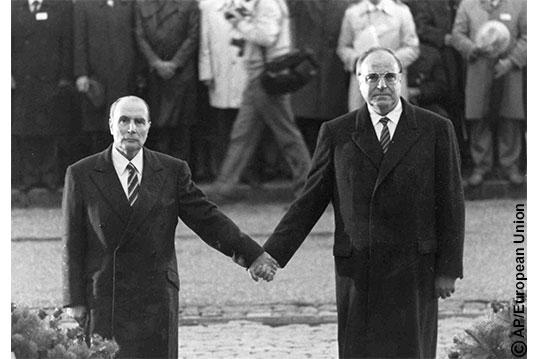
The French president Mitterrand and the German chancellor at their epic handshake on the fallen at Verdun. 1984. This moment resulted in the completion of the internal market, and in the end the European Economic and Monetary Union.
President Macron is currently in his second term as French president after the first (from 2017-2022). Now he is in his last term; until 2027. He has a sense of momentum and stands in a tradition of visionary like a lot of his predecessors.
Chancellor Merz is Bundeskanzler since 2025. A term lasts in Germany last 4 years (th.i, 2029) and could theoretically be prolonged forever, there is no maximum.
Merz can be characterized as a ‘Dranbleiber’. His candidacy for leader of the CDU-CSU failed two times, the third succeeded.
He pleaded in a summons- together with a.o. Jürgen Habermas- in 2018 for solidarity and a European army [3]
A new Treaty for a European policical and defense Union should be prepared.
In my view the principles ‘genuine solidarity’ and ‘concrete steps’ should be the base.
Organisationally
There can be build on the existing structures of the EU and ECSC.
The Commission will be the initiatior of policy.
The Council of Ministers decides on policy. Decisions are made with qualified majority.
That means that at least 55 % of the members-states confirm a decision, these representing
at least 65 % of the population of the EU. This is called ‘the rule of double majority’.
The European Court of Justice oversees compliance with the treaties.
In practice. A European army.
Bearing in mind the ideas of Monnet and Schuman, it is started with a relatively small
European army.
It could be connected with the existing German-Dutch army corps. Since 1995 the 13-th Dutch light Air Mobile Brigade is integrated in the 10-th German Panzer Division, which action is fully completed in 2023. Dutch armed vehicles are transformed to a medium brigade with the assistance of German Panzer.
3.000 Dutchmen are part of it.
The total German man-power in the brigade amounts to approx 30:000 men and women.
Also a small fraction of the French forces is integrated in this.
A consequence of the previous epic handshake between Mitterand and Kohl.
Dutch authorities retain full political and operational control over their own militaries. In the end the government decides if and when the unit is deployed.
In practice the Dutch forces fall under German command.
The nucleus of a European army
This ‘safety-valve’ could be a part of a new European army. Daily control is always for the commander in the field At distance the members-states retain control.
It could be foreseeable that more of these kinds of brigades are created within Europe.
Fe:
- In the South. one with French and Spanish forces in the neighbouring areas of the countries;
- Another one in the centre. one with German and Polish or Cze ch forces;
- A northern one. a Scandinavian one with Poland. I understand that the Polish language -the country is situated along the Baltic Sea- and Scandinavian languages are somehow similar.
In this way a European army of about 100:000 men and women is created. A starting-point.
The European Defense Community, the European Coal and Steel Community as a model ?
The purchase of military equipment is becoming more and more political since Trump is in power.
It is wise that Europe can rely more on its own producers.
I see four advantages:
- Becoming more independent from the US;
- Economies of scale. Now we have f.e. five producers of tanks and twenty different types
in respective armies; - A better attuning of material on European needs,
- Substantial cost reductions.
In this case, the rol of the EU should be more imperative.
Like with the common market, the EU protects and safeguards the functioning of this market.
Ownership, or favours and private procurement by governments for national producers should be ended.
The structure of the EU, which more or less the same as its predecessor the ECSC can be copied.
The European Commission supervises the free operation of this market. If threatened, it can act and
levy fines. Purchases can be rejected.
Preferably tragic events as the recent failure of a joint French-German project to build a new fighter jet should be prevented.
Also applies her. Expensive projects, ‘with a sensitive status’ bear greater risks. also because of cultural and language differences between involved countries.
But this experience shows the truth of Schumann’s words. Start with small steps.
Conclusion
Time is waiting
History happens, it can be grasped
The spirit of Monnet and Schuman will rejoice
Unity through diversity
The EU can anew be seen as a model
[1] https://european-union.europa.eu/principles-countries-history/facts-and-figures-european-union_nl.
[2] https://europa.eu/eurobarometer/.
[3] https://www.handelsblatt.com/meinung/gastbeitraege/aufruf-fuer-ein-solidarisches-europa-machen-wir-ernst-mit-dem-willen-unseres-grundgesetzes-jetzt/23204984.html.


